Author: rainbowpathjack

  • Work with Rainbow refugees on Rainbow resettlement issues

    The Progress Pride flag with striped arrows of white, pink, blue, brown and black added to a Rainbow flag. The light blue, pink and white stripes represent trans and non-binary individuals and the brown and black ones represent marginalised People of Colour (POC) communities. The black stripe has a double meaning as it is also intended for those living with AIDS and the stigma and prejudice surrounding them, and those who have been lost to the disease.

    On 11 August 2023 Rainbow Path submitted to the Select Committee considering a petition calling for a Rainbow subcategory within the current NZ Refugee Quota programme. On 23 September, the Labour Party announced its policy to implement this change if re-elected. As Rainbow Path’s submission to the Select Committee noted, there are other steps needed for such a policy to make a meaningful difference for Rainbow asylum seekers and refugees. We reiterate our call for the Ministry of Business, Innovation, and Employment (MBIE) to develop a regular consultation mechanism with Rainbow Path and other Rainbow refugees that would:

    • identify ways to collect and monitor data about the extent to which Rainbow refugees are being resettled in Aotearoa, as baseline information for policy decisions including the 2025 review of subcategories within the New Zealand Refugee Quota Programme;
    • discuss the extent to which current refugee status determination and resettlement pathways are safe and accessible for Rainbow people, as a basis for identifying potential improvements;
    • consider ways to remove financial barriers preventing Rainbow communities from participating in the Community Refugee Sponsorship programme;
    • explore how the Refugee Resettlement Strategy can better meet the specific needs of Rainbow refugees;
    • identify ways that Immigration NZ can enable trans and intersex asylum seekers and refugees to have useable official documents with their correct name and gender marker; and
    • identify and address other legal or policy issues that have a specific or disproportionate impact on Rainbow refugees and asylum seekers, for example current family reunification and partnership visa settings.

    Rainbow Path’s full submission to the Select Committee is copied below.

    Submission to the Select Committee

    11 August 2023

    Camilla Belich

    Chair

    Education and Workforce Committee

    Email: ew@parliament.govt.nz

    Dear Hon Camilla Belich,

    Rainbow Path welcomes the opportunity to provide a written submission to the Education and Workforce Committee on the petition and proposal to create a Rainbow subcategory within the current New Zealand Refugee Quota Programme.

    It is important that the lived experiences of Rainbow refugees and our organisations are prioritised in this discussion. This is not only to ensure the voices of refugees are heard, but also so that legal, policy or regulatory proposals are based on an accurate assessment of the current problems, and of the likely effectiveness of any proposed solutions.

    Background information about Rainbow Path

    Rainbow Path is a community and a peer support and advocacy network for LGBTQIA+ refugees and asylum seekers living in Aotearoa. We are led by Rainbow people with lived experience as refugees and asylum seekers, with support from other Rainbow human rights defenders. Rainbow Path provides social support and rights-based information in-person and online and runs Rainbow-competency training for refugee sector organisations and refugee-competency training for Rainbow community organisations. We also participate in government consultations including the National Refugee Resettlement forum and the Auckland Asylum Forum.

    Rainbow Path empowers Rainbow refugees and asylum seekers to lead advocacy on our human rights. Our advocacy work, including this submission, is based on the practical realities of what it means to be a Rainbow refugee. For quota refugees, that includes Rainbow refugees’ experiences seeking support from the United Nations refugee agency (UNHCR), our assessment by Immigration NZ before travelling to Aotearoa and the resettlement support we receive upon arrival here.

    Rainbow Path is also aware that one of our Steering Committee members, Eli Rubashkyn, was invited to send the Committee an individual submission. As that submission covers some background information about Rainbow refugee initiatives in overseas jurisdictions, we have not focused on that material in our submission.

    Heightened challenges faced by Rainbow refugees

    Rainbow Path has read the submissions from Hafsar Tameesuddin from the Asia Pacific Refugee Rights Network and from the Ministry of Business, Innovation and Employment (MBIE). We strongly agree with the statements in both submissions about the heightened vulnerability and challenges faced by LGBTQIA+ refugees in our countries of origin, transit countries and when resettled here in Aotearoa. Those risks are even greater for Rainbow human rights defenders.

    Some of us are forcibly displaced because of our ethnicity and religion or due to war and conflicts. We just happen to be Rainbow as well, as there are Rainbow people in all populations. But even if our original persecution was not about being Rainbow, at each stage of our journey to safety we face extra challenges because of our sexual orientation, gender identity or expression, or variation of sex characteristics (SOGIESC status).

    We often have no family or community support when we are trying to flee persecution, and we may be fleeing from them as well. Most of us do not feel safe to be with our ethnic or religious communities, and we have to hide our Rainbow identity, both for our own safety and to protect our family or a partner.

    The country we are fleeing may criminalise our sexual orientation under so-called sodomy laws and criminalise our gender identity or expression under so-called ‘cross-dressing’ or ‘public immorality’ laws, which are often inherited from colonisation. There may also be honour killings against Rainbow people under religious laws. Our family and wider community may shun intersex people born with variations of sex characteristics, and if there are any available medical interventions, they are most likely to be harmful and non-consensual. Most countries we have fled from do not allow us to change our name or gender marker on ID cards or passports that we must show to cross borders and when we make our refugee claim. This exposes trans people and those intersex people who do not resemble their ID documents to elevated risk.

    There is also no visibility of Rainbow people and our explicit rights to protection within the humanitarian sector. Despite efforts by a few agencies including Rainbow NGOs, there are often no safe places for Rainbow people in refugee camps. In many other countries we wait in the local community we have fled to, we often have no right to work and are vulnerable to harassment including from police, especially in places where we are criminalised or have no anti-discrimination protections and religious and other community leaders sanction violence against us.

    After such a long journey when it has never been safe to disclose who we are, we often don’t know if and when it’s safe to disclose being Rainbow. We may not have the words to describe who we are. There is often a lot of internalised shame. Our first languages often only have derogatory terms for Rainbow people. Some of us come from cultures that do have traditional terms for some Rainbow identities, but these identities are often different from western, English language concepts and terms. When we seek asylum or reach the country of resettlement, we may only have just started to explore our sexuality, gender identity or expression or what it means to be intersex.

    Once we are here in Aotearoa, service providers and government agencies often assume our main support network will be our family or other migrants from our country of origin. For example, we may be housed or resettled together with our own ethnic community. But for Rainbow refugees this is likely to result in more harm, especially if we are resettled outside of main cities where there is no access to support from Rainbow communities.

    All these factors mean that many Rainbow refugees hide or delay disclosing our Rainbow identities, especially if we are also able to seek asylum under other grounds of persecution. It is vital that refugee status determination processes recognise these barriers and do not assume late disclosure raises credibility issues, and that all refugee resettlement pathways are safe and accessible for Rainbow people.

    A Rainbow subcategory within the current New Zealand Refugee Quota Programme

    Rainbow Path welcomes the intention of the petition and the attention it gives to the huge gaps in responses to the persecution and displacement of Rainbow refugees.

    We strongly support identifying and implementing safer and faster pathways for Rainbow refugees and asylum seekers’ resettlement in Aotearoa. A Rainbow quota is one of the potential solutions. Our concern is that, on its own, it is unlikely to be effective. We make this statement cautiously and would have huge concerns if it is seen as an excuse to merely maintain the status quo. Instead, it is the basis of our call for genuine engagement with Rainbow refugees and organisations about the mix of existing and new policy levers needed to create safer and faster pathways for Rainbow refugees to be resettled in Aotearoa.

    In its submission, MBIE raises potential concerns about whether a Rainbow subcategory would create any unintended consequences. The two examples MBIE cites are either “inadvertently putting people at greater risk as their status may be more visible; or alternatively creating incentives for people to claim to be LGBTIQ+ to gain access to priority resettlement”. 

    Rainbow Path supports informed decision-making but notes that protecting the privacy and safety of Rainbow refugees is a priority, whatever pathways are being considered. Furthermore, privacy of individuals does not mean that UNHRC has the luxury of shying away from reaching out to support Rainbow refugees. One of the reasons why there has been community support for a separate Rainbow refugee subcategory is because it offers powerful symbolism and hope, in the context of Rainbow people fleeing countries that have ignored the human rights of their Rainbow citizens and other Rainbow people residing there. 

    Many Rainbow refugees come from countries where there are no positive terms or messages for Rainbow people and our human rights. Therefore, it is vital that the human rights of our communities, and the protection from violence and discrimination guaranteed under international human rights law, is visible in UNHCR’s and MBIE’s work. 

    We would also like to point out that simply creating a subcategory does not mean that anyone who is a member of the relevant marginalised, prioritised group will be eligible to apply. The refugee resettlement system has many checks and balances. Only those Rainbow people who have been recognised as refugees by UNHCR because they are fleeing persecution will have access to this pathway. Rainbow refugees are also not the only group whose protected status is based on self-identification. This is also the situation for many people who are persecuted because of their political opinion or religious beliefs. 

    Even if New Zealand were to adopt a Rainbow refugee subcategory, it is unlikely to be developed in the short term. Therefore, it is vital that immediate attention is given to exploring how other existing pathways can be used to resettle Rainbow refugees speedily and safely in Aotearoa.

    Lack of data about the use of existing options

    MBIE’s submission to the Committee notes that currently most Rainbow quota refugees “are normally referred under general protection or as urgent or emergency cases where they are submitted outside the normal selection mission cycle”.

    In Rainbow Path’s experience, most of our members who have come to Aotearoa fleeing persecution because of their sexual orientation, gender identity or expression or variations of sex characteristics have sought asylum in Aotearoa, not overseas through UNHCR. Some of our members who arrived as quota refugees are very prominent within refugee and/or Rainbow communities. Despite that visibility, they have only been contacted by a small number of other quota refugees who sought asylum because of persecution based on their Rainbow identity. This raises concerns for us about the extent to which the current general protection and urgent or emergency pathways are being used effectively to meet the needs of Rainbow refugees.

    Rainbow Path strongly supports the use of discretionary humanitarian visas to respond to specific emergency situations. Our concerns are the absence of data about whether these visas are being used effectively for Rainbow refugees from New Zealand’s current priority countries (Afghanistan and Ukraine), and whether the specific situation for Rainbow people in other countries (for example Uganda) is taken into account. New Zealand can learn from the experience of other countries, particularly Canada. We are aware, for example, that in early 2022, the Canadian Government decided to admit an additional 600 LGBTIQ+ Afghan refugees across all of its resettlement pathways.

    Rainbow Path is frequently and increasingly contacted by Rainbow people in high-conflict countries overseas or those where Rainbow people generally, or trans people specifically, are targeted under laws. This includes being contacted by people in Afghanistan and Ukraine, seeking support because of their heightened vulnerability. These approaches have grown this year, particularly with heightened attacks against trans people in most regions. Rainbow Path is only able to provide people with publicly available information from UNHCR and Rainbow community organisations such as ORAM and Rainbow Railroad. We would welcome the opportunity to work with UNHCR and MBIE on ways to safely enable Rainbow asylum seekers and refugees to have the same opportunity to access existing emergency pathways.

    Rainbow Path recommends that MBIE is required to collect and monitor data about the extent to which Rainbow refugees are being resettled in Aotearoa, as baseline information for identifying and then addressing barriers and gaps. This information will be necessary for any future policy work including the 2025 review of subcategories within the New Zealand Refugee Quota Programme.

    While UNHCR does not currently collect SOGIESC data, we note that the 2021 Global Roundtable on Protection and Solutions for LGBTIQ+ People in Forced Displacement prioritised such data collection in its recommendations, including to:

    • Create environments in which it is safe for LGBTIQ+ persons to share their experiences . . . (Section C: Recommendation 1)
    • Encourage collection of data on the experiences of LGBTIQ+ people by supporting humanitarian staff to overcome the fear of failure and to effectively mitigate fear of doing harm (Section C: Recommendation 2) and
    • Conduct appropriate respectful collection of data, exercising extreme care for the safety of individuals and security of their personal information, disaggregating data, and engaging in careful stewardship, including anonymization and access controls. (Section L, recommendation 2).

    Lack of resourcing for community-based pathways

    Two Rainbow Path members participated in the 2021 Global Roundtable on protection and solutions for LGBTIQ+ people in forced displacement. MBIE’s written submission mentions one of the recommendations from that report, namely:

    “. . .  to consider a Humanitarian Visa Pathway for LGBTIQ+ persons with acute protection risks in crisis situations (such as for trans and gender non-conforming individuals), whereby vetted civil society organisations can refer LGBTIQ+ displaced persons in origin or asylum countries to a community sponsorship program”.

    As noted above, Rainbow Path welcomes the opportunity to explore the use of a Humanitarian Visa Pathway for Rainbow people. However, it is vital to realise that where community sponsorship programs have been developed for Rainbow refugees in other countries, they have been linked to well-resourced Rainbow community organisations. These groups have the funding, staff and accommodation to support Rainbow refugees. There are no equivalent Rainbow organisations with such resourcing in Aotearoa.

    Rainbow Path has met with HOST International Aotearoa to discuss the Community Refugee Sponsorship programme here and encouraged Rainbow community organisations to attend their informational webinar. However, without resourcing for Rainbow community organisations here, it is not feasible for Rainbow communities to take on the costs attached to this model.

    The importance of meaningful participation by Rainbow refugees

    Finally, at the heart of Rainbow Path’s submission is the necessity for MBIE to engage meaningfully with Rainbow refugees and organisations about resettlement pathways for Rainbow refugees. This is vital to ensure that proposals will actually work for Rainbow refugees.

    Rainbow Path recently presented to the National Refugee Resettlement Forum. We appreciated the opportunity to meet with other refugees and refugee organisations. However, there were few decision makers in the room.

    Our main advocacy work over the last four years has been attempting to resolve the lack of legal gender recognition options for asylum seekers and refugees living in Aotearoa. That work covers the portfolios of both Immigration NZ and the Department of Internal Affairs (DIA). Rainbow Path collaborated with DIA to co-organise and co-facilitate community consultations about legal gender recognition solutions for people born overseas. While that work was ultimately deferred, the process itself is one that Rainbow Path valued and that enhanced the advice DIA received for its policy work.  We have never had any similar high-level engagement with Immigration NZ / MBIE about the role it can play in enabling Rainbow asylum seekers and refugees to have official documents with their correct gender marker and/or name. 

    Rainbow Path recommends that MBIE works with Rainbow Path to develop a regular consultation mechanism on Rainbow refugee resettlement issues. Its purpose could include, for example, to:

    • identify ways to collect and monitor data about the extent to which Rainbow refugees are being resettled in Aotearoa, as baseline information for policy decisions including the 2025 review of subcategories within the New Zealand Refugee Quota Programme;
    • discuss the extent to which current refugee status determination and resettlement pathways are safe and accessible for Rainbow people, as a basis for identifying potential improvements;
    • consider ways to remove financial barriers preventing Rainbow communities from participating in the Community Refugee Sponsorship programme;
    • explore how the Refugee Resettlement Strategy can better meet the specific needs of Rainbow refugees;
    • identify ways that Immigration NZ can enable trans and intersex asylum seekers and refugees to have useable official documents with their correct name and gender marker; and
    • identify and address other legal or policy issues that have a specific or disproportionate impact on Rainbow refugees and asylum seekers, for example current family reunification and partnership visa settings.

    Thank you again for the opportunity to make this submission. Rainbow Path realises that the Select Committee’s time is very constrained in the lead-up to the general election. However, we would welcome any opportunities now or in the future to meet with the Select Committee or individual members to discuss and progress these issues.

    Ngā mihi

    Rainbow Path’s Steering Committee
  • Call for a Rainbow Refugee quota on World Refugee Day

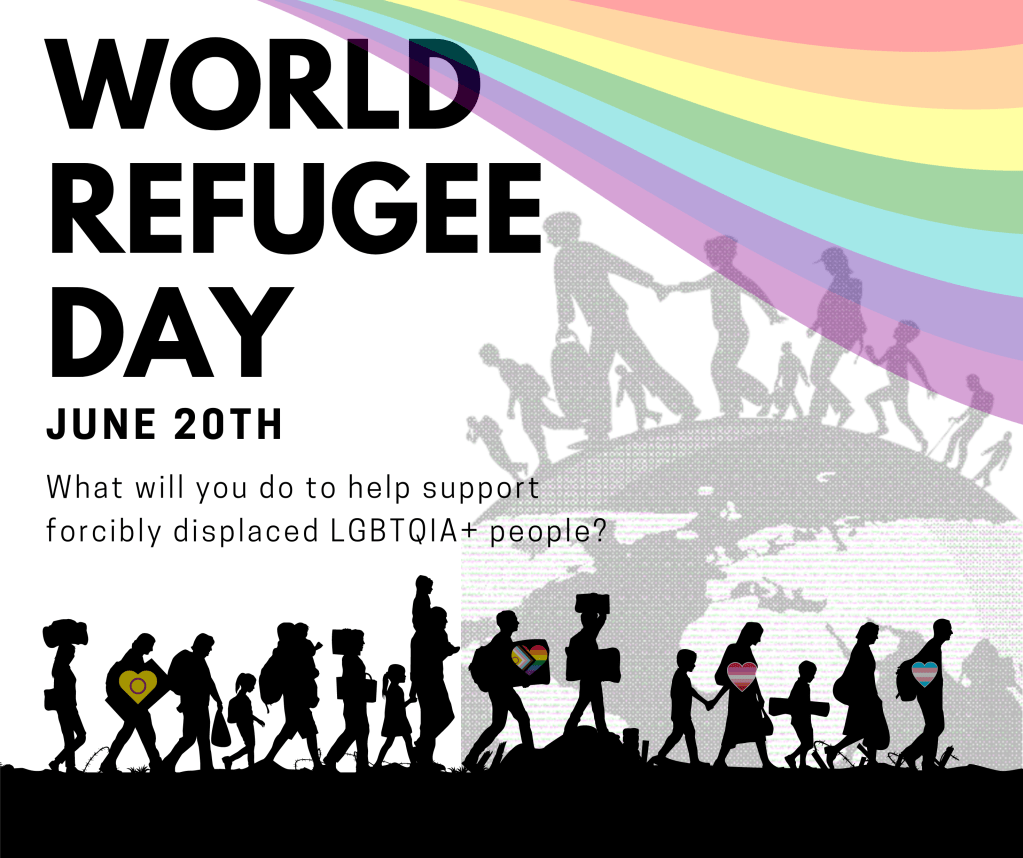
    On World Refugee Day, the Asia Pacific Refugee Rights Network presented a petition to the New Zealand Parliament calling for a Rainbow Refugee quota, that would set aside some of the 1,500 Refugee quota places each year specifically for Rainbow refugees.

    Rainbow Path supports identifying and implementing safer and faster pathways for Rainbow refugees and asylum seekers’ resettlement in Aotearoa. A Rainbow quota is only one of the potential solutions needed, and is only as good as the measures complementing it. To be effective it would require meaningful participation of Rainbow refugees at every step of its design and implementation. This is vital to ensure that proposals will actually work for Rainbow refugees.

    An image for World Refugee day, June 20th. What will you do to help support forcibly displaced LGBTQIA+ people? Background showing a group of refugees walking across the globe, some of which are rainbow.
    Text: World Refugee Day June 20th. What will you do to help support forcibly displaced LGBTQIA+ people? Image description: a group of people and children walking carrying everything they have. Intersex, lesbian, trans, and rainbow hearts can be seen on some people, showing that many forcibly displaced people are LGBTQIA+.

    To be sustainable, a Rainbow Refugee quota will also require supporting and funding Rainbow community organisations in Aotearoa, especially those led by Rainbow refugees and migrants, so they are able to support asylum seekers and refugees when they arrive and through their ongoing resettlement process.

    It is also unlikely that a Rainbow quota would be developed in the short term, so any commitment to explore this option must not be used as a panacea to prevent the use of existing levers to speedily and safely resettle Rainbow refugees here.

    August 31st is the last day of Parlaiment before this year’s election. So it is uncertain what progress this petition will make in that limited timeframe. If it is referred to a Select Committee, the Committee might seek further details from submitters and could potentially issue a report with recommendations.

  • Government fails to provide gender recognition for trans and intersex people born overseas

    Yesterday, the Department of Internal Affairs updated its website to announce that it is “deferring  further work on developing a process for people born overseas to register their gender”. 

    Rainbow Path has conveyed to the Department the huge level of disappointment and frustration of our members, who are left without having useable IDs. This impacts on every aspect of our lives.

    People born overseas, living here in Aotearoa, are frequently asked to show an identification document (ID) to prove our immigration status and eligibility for publicly funded services.  As people of colour, it is more likely someone will assume we are born overseas and request to see our ID. Yet most trans asylum seekers and refugees, and many migrants, do not have any photo ID with our correct name and gender marker. 

    Today’s decision is a huge backward step from commitments the department and the previous Minister have made to trans refugees, asylum seekers and migrants. 

    The Births, Deaths, Marriages, and Relationship Registration Bill was passed in December 2021, giving trans and intersex people a simple process to amend the gender on a NZ birth certificate. In her media release at the time, Minister Tinetti committed to find solutions for Rainbow Path members and others who do not hold a NZ birth certificate:

    “I would like to acknowledge that there will be disappointment from overseas-born New Zealanders as they will not be able to access self-identification at present. This is because the changes only apply to New Zealand birth certificates at this stage. Work will be done to address this, starting with further consultation with those affected. This will only further strengthen the milestone we have achieved today,” Jan Tinetti said.

    Consultation by the department in 2022

    Since the Bill was passed, the department has continued to consult trans and intersex people. Partly, this was to help finalise details about the self-identification process for NZ birth certificates that would be put in regulations before the new law comes into effect on 15 June 2023.

    In addition, because the Bill does not cover trans and intersex people born overseas, the department started to consult trans asylum seekers, refugees and migrants about the IDs we currently have and aren’t able to update, as the initial step towards exploring potential solutions.This two-stage consultation process was clearly spelt out in the department’s engagement strategy, on its website:

    “13. Work to resolve the issues for people born overseas will progress on a different timeline. This timeline will be published in due course. A second round of engagement on policy options is intended in 2023, providing another opportunity for people to share their views. While solutions to these issues will not come into force alongside the self-identification process, Government has committed to pursuing a solution.”

    Based on these commitments, Rainbow Path members put in months of voluntary work encouraging trans and intersex people born overseas to share their experiences living in Aotearoa with no useable ID. Rainbow Path collated those stories into its submission to the department in July 2022. 

    Reneging on those commitments

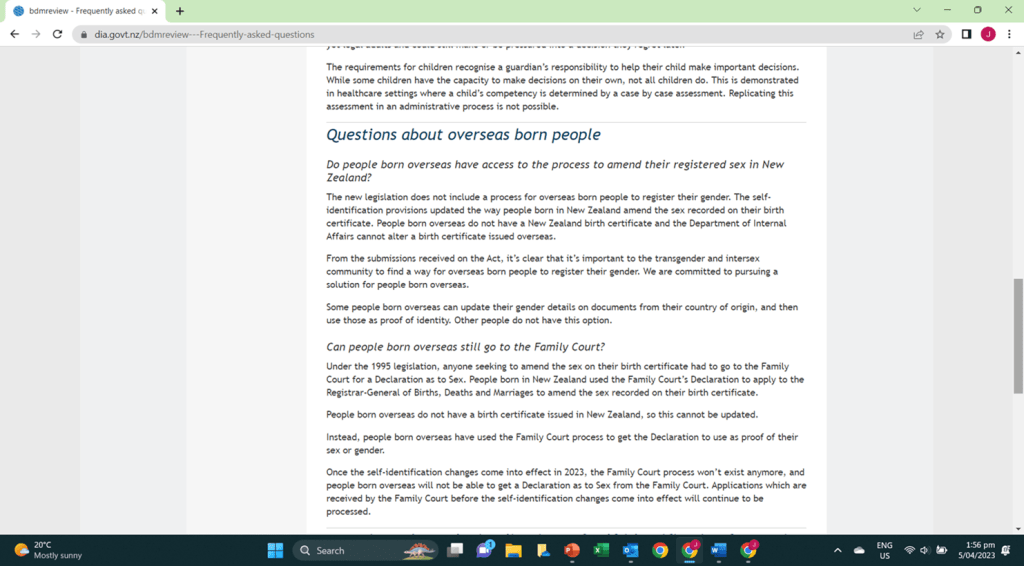
    As the screenshot below shoes, at lunchtime yesterday, Wednesday 5 April, the department’s online FAQ about this work (the BDM review) still said “We are committed to pursuing a solution for people born overseas”.  

    Half an hour later, that sentence had been removed from the FAQ.

    Soon after, the following update appeared as a new tab titled “Recognising gender for people born overseas” on the “Recognisng gender on birth certificates” page of the department’s website. A screenshot of the department’s full update is also copied at the bottom of this blog post.

    A summary of the department’s 5 April update 

    .After a short introduction, the department makes four main points:

    1. Feedback from consultation showed the issues are complex and there is no clear solution. 
    2. Two small improvements are planned over the next 12 months, enabling trans and intersex people to amend the gender on their Citizenship Certificate and their Refugee Travel Document. 
    3. Any further work on potential solutions is deferred until the department develops digital identity tools, so the department can “assess how digital identity tools could contribute to solutions”.
    4. There are no timeframes for the development of digital identity tools and any further updates will be provided on this department webpage.  

    Rainbow Path’s response to that update

    Rainbow Path has been advocating for a solution for over five years. Over that time we have written many submissions, documented the experiences of our members, met with politicians, and even helped the Department of Internal Affairs consult with our communities. 

    The next promised step was to seek feedback on potential solutions. That was the agreed process to talk through the pros and cons of different options and clarify potential solutions. The department has unilaterally decided to give up on that process. 

    The two operational improvements that the department has signalled will take place over the next 12 months will have very minimal additional benefit for Rainbow asylum seekers and refugees or migrants. 

    • The department had already committed previously to ensuring that citizens would be able to update their gender marker on a Citizenship Certificate, rather than just being issued an Evidentiary Certificate with the corrected details. (See for example page 12 of the government’s response to the Working Group for Reducing Barriers to Changing Registered Sex.)   
    • Asylum seekers often have to wait years to be accepted as a refugee and aren’t eligible for a Refugee Travel Document (RTD) until then. These proposals will make no difference to them.
    • Once we are accepted as a refugee, it is already often possible for us to amend our gender on a Refugee Travel Document (RTD). Formalising this policy does not fix the problem that we cannot change our name until we are permanent residents, meaning all our documents (including our RTD) are of little use because they have our wrong name.  Finally, the RTD is seldom recognised as proof of one’s identity, even by government agencies. 

    Rainbow Path’s faith in the potential of digital identity tools is minimal at this point, given the documents currently required to change details online. For example, it was very hard for our members to even get a Vaccine Pass during the COVID-19 pandemic. We would have valued the opportunity to be consulted by the department about potential digital identity tools, to provide a reality check of how they may or may not work for trans and intersex asylum seekers, refugees, and migrants.

    Now we are left with no meaningful progress, an indefinite waiting time while the department explores whether digital identity tools might help, and no formal consultation processes with our communities.

    Rainbow Path has told officials at the Department of Internal Affairs that it is vital that any ongoing work in the digital identity space involves meaningful consultation with trans asylum seekers, refugees and migrants born overseas.

    Rainbow Path is asking for your support as we keep pushing for essential legal protections for trans and intersex refugees, asylum seekers and migrants including:

    • an Identity Document that recognises who we are and
    • making sure trans and intersex people are explicitly included in the Human Rights Act and in hate speech and hate crime laws.

    Please keep fighting alongside us until those rights exist for all trans and intersex people.

    We should never settle for legal protections that only apply to people born here

    Sceenshot if the department's 5 April update. The full text is available online.
  • Help create a legal gender recognition solution for people born overseas

    If you are a trans, non-binary, or intersex person who was born overseas, please register for one of these sessions hosted by the Department of Internal Affairs. They take place THIS THURSDAY 30 JUNE and on TUESDAY 5 JULY, from 6.30 – 8pm.

    Colourful  stylised images of people as triangles with circular heads

    The new BDMRR Act only introduces a self-ID process for people born in Aotearoa. These online sessions are the first steps towards finding a solution so that overseas born people can register their gender in Aotearoa.

    Rainbow Path members will be participating in both sessions. Register now as spaces are limited – we would love to see both calls fully booked. There are a few details below and more when you click on the registration link.

    ———————————————————-

    Information supplied by the Department of Internal Affairs

    “A self-identification (self-ID) process for birth certificates will be available from mid-2023. This is significant for transgender, non-binary, intersex, and takatāpui New Zealanders, who will be able to amend the sex on their birth certificate without going through an intrusive and costly process.

    At present, the new self-ID process does not apply to people born overseas who don’t have a New Zealand birth certificate.

    Government are committed to pursuing a solution to enable overseas born people to register their gender. If you were born overseas, we’d love to hear your perspective to help us find a solution.”

  • Select Committee recommends a legal gender recognition solution for asylum seekers and refugees

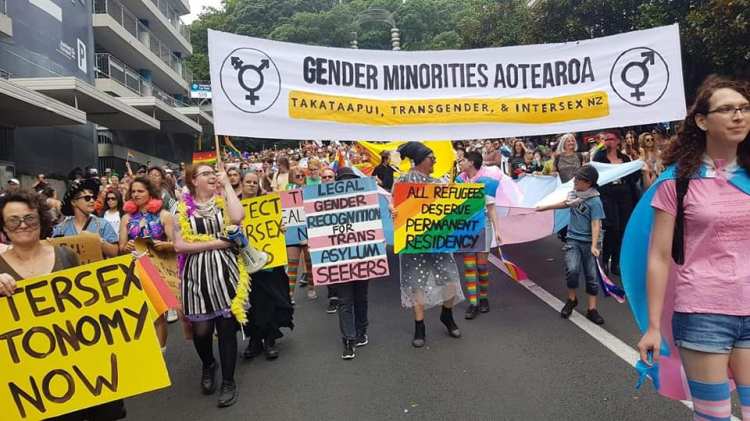
    All people have the right to legal gender recognition, whatever their immigration status. Rainbow Path strongly believes that Aotearoa can be a country where that is a reality for every trans, non-binary and intersex person living here. Everyone should be able to obtain official New Zealand documents with their correct name and gender.

    Placard made by a Rainbow Path member

    People who follow our Facebook page will know the huge support there has been for Rainbow Path’s campaign linked to the BDMRR Bill last year. We have previously shared our frustration that no solutions for people born overseas were included in the Bill. Recommendations to do further work on this issue also made no explicit reference to asylum seekers, refugees or migrants on temporary visas.

    After a huge amount of last minute lobbying at the end of last year, Rainbow Path watched Parliament TV on 9 December, hopeful that our lived experiences might have been enough to make a difference. In our Facebook post we described how that felt.

    “As the Bill went through its third reading, excited Rainbow Path members and allies were sitting in front of the screen, listening closely to the speeches and cheering each time our Rainbow refugee and asylum seeker communities were acknowledged. What was remarkable is not only that it was passed unanimously, but also the commitment we got to finding solutions for people born overseas, during the 18 months between now and when the regulations for self-identification come into effect.”

    Our ongoing lobbying has been to ensure this includes asylum seekers, refugees and migrants on temporary or timebound visas, as well as permanent residents and citizens born overseas. A huge thank you from the bottom of our hearts to all our allies for your unrelenting support.

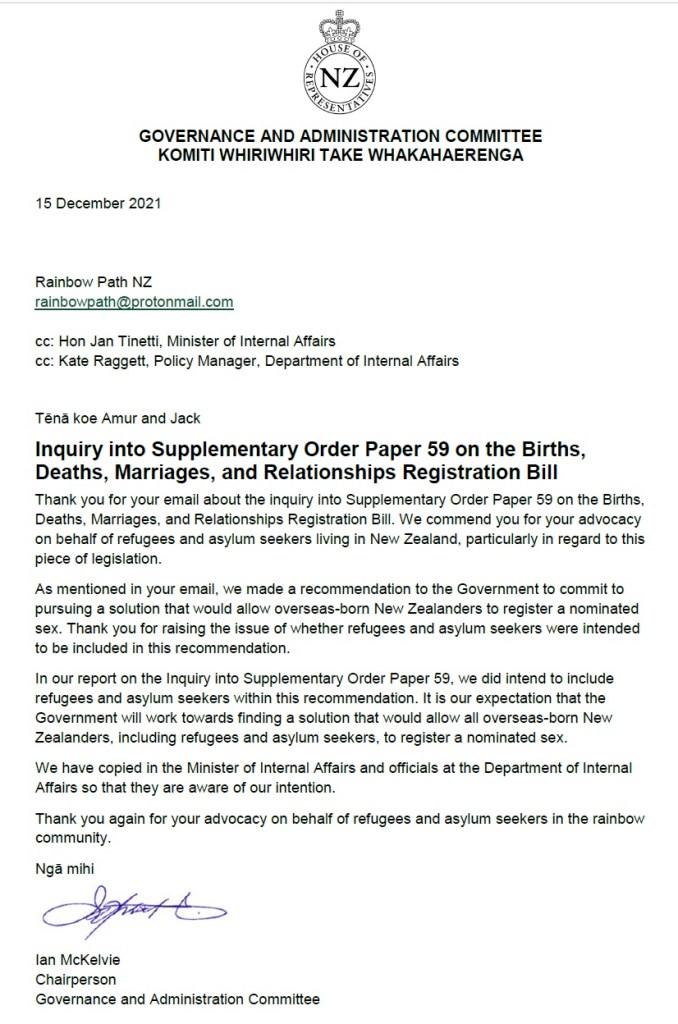
    Less than a week later the Select Committee wrote to Rainbow Path confirming that their recommendation applied to all overseas-born New Zealanders, including refugees and asylum seekers. We have shared the letter in full below.

    Watch this blog and our Facebook page to see details of the community discussion we will be hosting on 16 and 21 June from 6.30 – 8pm. We want to hear from any overseas-born trans, non-binary or intersex people living in Aotearoa, especially those who are unable to get their gender and name recognised in their country of origin. Together we will identify the range of different barriers we face and explore potential solutions.

    Select Committee’s letter to Rainbow Path confirming that their recommendation includes all overseas-born New Zealanders, including refugees and asylum seekers

    GOVERNANCE AND ADMINISTRATION COMMITTEE
    KOMITI WHIRIWHIRI TAKE WHAKAHAERENGA

    15 December 2021

    Inquiry into Supplementary Order Paper 59 on the Births, Deaths, Marriages, and Relationships Registration Bill

    “Thank you for your email about the inquiry into Supplementary Order Paper 59 on the Births, Deaths, Marriages, and Relationships Registration Bill. We commend you for your advocacy on behalf of refugees and asylum seekers living in New Zealand, particularly in regard to this piece of legislation.

    As mentioned in your email, we made a recommendation to the Government to commit to pursuing a solution that would allow overseas-born New Zealanders to register a nominated sex. Thank you for raising the issue of whether refugees and asylum seekers were intended to be included in this recommendation.

    In our report on the Inquiry into Supplementary Order Paper 59, we did intend to include refugees and asylum seekers within this recommendation. It is our expectation that the Government will work towards finding a solution that would allow all overseas-born New Zealanders, including refugees and asylum seekers, to register a nominated sex.
    We have copied in the Minister of Internal Affairs and officials at the Department of Internal Affairs so that they are aware of our intention.

    Thank you again for your advocacy on behalf of refugees and asylum seekers in the rainbow community.

    Ngā mihi


    Ian McKelvie

    Chairperson Governance and Administration Committee


  • Rainbow Path’s concerns and hopes for the BDMRR Act

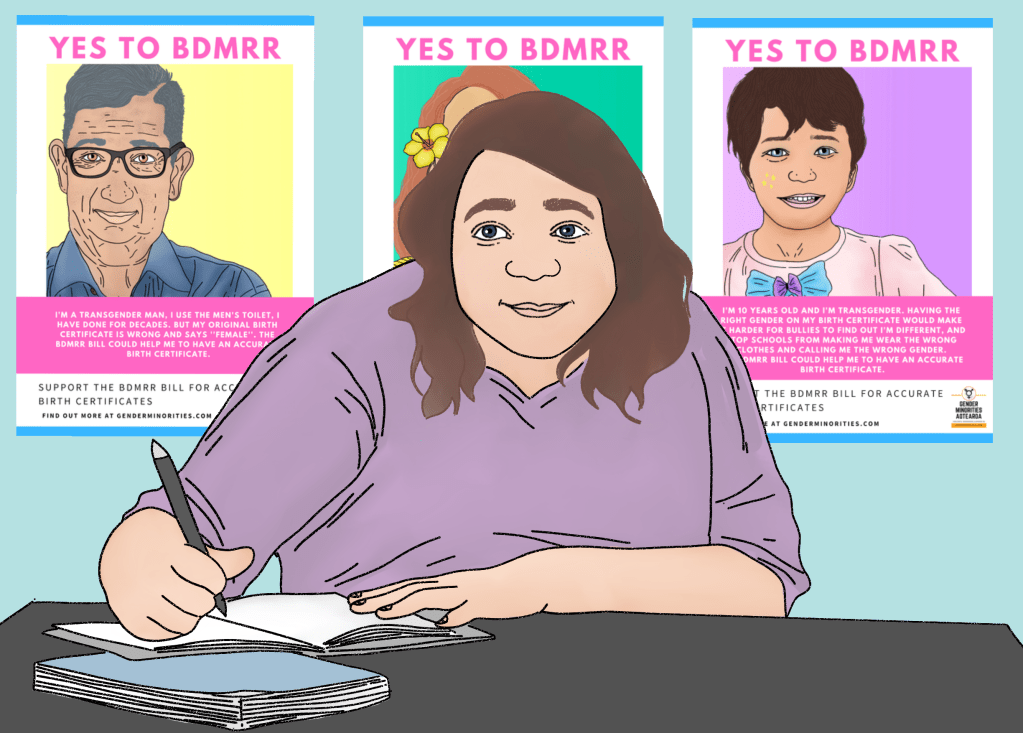
    A trans person writing a submission with three posters behind them that say "Yes to BDMRR".
    Artist: Huriana Kopeke-Te Aho’s illustration for the Counting Ourselves report

    The Births, Deaths, Marriages and Relationships Registration (BDMRR) Bill returns to Parliament this week. Trans asylum seekers, refugees and migrants are some of the groups most often asked to show a photo ID to prove their immigration status in Aotearoa. Yet they are currently excluded from the Bill’s provisions. It’s not too late to commit to addressing this gap.

    Rainbow Path’s recommendations about the BDMRR Act

    Rainbow Path made a written and private oral submission in support of the Select Committee Inquiry into  Supplementary Order Paper 59 but also noted significant gaps left by the proposed changes to the Births, Deaths, Marriages and Relationships Registration Act 1995.

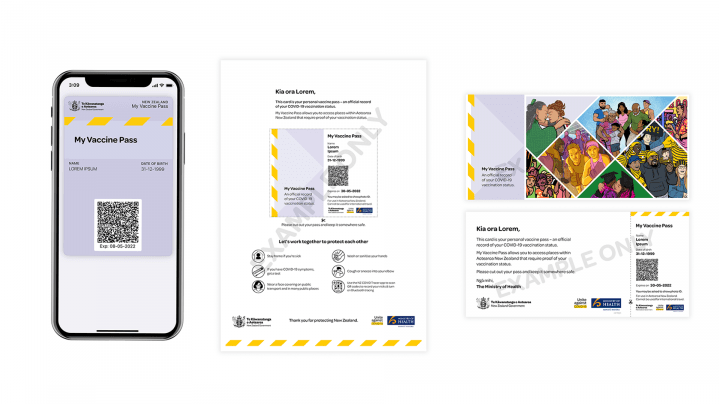
    The need for a NZ Identity document with the correct name and gender marker has become even more important now that we have Vaccine Passes. People are likely to be asked more often to show a photo ID to verify that the Vaccine Pass they present belongs to them. This will be another barrier for trans and intersex people whose overseas IDs have the wrong name and/or gender marker. 

    In our submissions, and the wider campaign supported by Gender Minorities Aotearoa, Rainbow Path made three related recommendations. These were to ensure that all trans and non-binary people born overseas can access a New Zealand ID with their correct name and gender, through a simple administrative process based on self-determination. Specifically, we recommended that:

    1. permanent residents, who currently can amend these details, should retain that right – but with a simplified process too.
    2. trans asylum seekers and Convention refugees on temporary visas should be able to obtain a document with these correct details, such as a Certificate of Identity or Refugee Travel document issued by the Department of Internal Affairs or Immigration NZ and
    3. migrants on temporary visas should be able to get some form of New Zealand ID as well. 

    What did the Select Committee recommend?

    Rainbow Path was really glad to see this first recommendation in the Select Committee’s report:

    • “That the Government commit to pursuing a solution that would allow overseas-born New Zealanders to register a nominated sex, and to carrying out further consultation with relevant individuals and groups to this end.”

    Does this recommendation include asylum seekers or refugees?

    It is very unclear to Rainbow Path whether this recommendation includes all overseas-born New Zealanders, specifically asylum seekers and refugees and migrants who are here on temporary or time-bound visas. 

    We are very concerned that this may exclude asylum seekers and refugees at the point when they are most vulnerable to discrimination and struggle to open a bank account, find accommodation or get work without a usable identity document.

    Our concerns are because:

    • There is no mention of asylum seekers and refugees in the Select Committee’s report and
    • in the Department of Internal Affairs’ report to the Select Committee its advice around the Select Committee’s first recommendation was focused solely on New Zealand citizens and permanent residents born overseas. 

    What did the Department of Internal Affairs advise the Select Committee about asylum seekers and refugees?

    The Department’s report specifically notes that “expanding access to documentation beyond citizens and permanent residents is beyond the scope of the Act”. It does note, however, that:

    • “Work is already underway with Immigration New Zealand at an operational level to address how best to assist transgender asylum seekers (who are on timebound visas) with gender recognition documentation while they await confirmation of refugee status (and thereafter permanent residency).”

    Rainbow Path is aware of that work because it has resulted from our continued advocacy for nearly three years, and has required multiple letters to Ministers and departmental officials. Now is a vital opportunity for the government to signal a commitment to addressing these concerns within the same time frame as the regulations being developed to support this Bill.

    This will require thinking outside the restrictions of current policy settings or interpretations. Legal gender recognition should be available to any trans or intersex person in Aotearoa, whatever their immigration status. That is the international human rights obligation set out in the Yogyakarta Principle 31 and the practical step needed to ensure all trans or intersex people here can navigate everyday life with safety, dignity and respect.

    Why this is even more important due to COVID-19

    Trans asylum seekers and refugees without accurate identity documents are one of the groups struggling to obtain a Vaccine Pass that they can safely use. This highlights yet again why trans and intersex people born overseas need a New Zealand identity document with their correct name, photo and gender marker.

    Rainbow Path has recommended that trans and intersex asylum seekers and Convention refugees should be able to self-identity their name and gender on Certificates of Identity and Refugee Travel documents. This is an important interim step, as these may be the only NZ photo IDs that some asylum seekers and refugees can obtain.

    However, there is very limited recognition of these documents in Aotearoa, even though they are official NZ travel documents. For example, they aren’t included as documents you can use to sign up for My COVID record.  If they are not listed as accepted forms of official IDs there, it’s even less likely that they will be accepted by venues and service providers.

    Rainbow Path has asked the Government to:

    • clarify that the work signalled in the first recommendation in the Select Committee’s report covers any trans or intersex person born overseas who is living in Aotearoa and
    • commit to introducing legal gender recognition solutions for trans and intersex asylum seekers, refugees and migrants between now and when amendments to the Births, Deaths, Marriages and Relationships Registration Act 1995 commence in 2023.

    Rainbow Path members will be glued to our screens when the Bill returns to Parliament this week. We hope that this will be a moment that all of our trans and intersex communities can celebrate. Rainbow Path welcomes any opportunities to work meaningfully with Ministers, government officials and other trans and intersex community organisations to achieve legal gender recognition for us all.

    The Select Committee report covers other issues raised by submitters too. Gender Minorities Aotearoa has written this blog analysing the Select Committee’s responses to the key points made in their submission.

    Three images of a Vaccine Pass
    Vaccine pass images from covid19.govt.nz

  • Support Rainbow Path’s submission on the BDMRR Bill

    Midnight this Tuesday 14 September is the closing date for submissions on the Births, Deaths, Marriages and Relationships Registration (BDMRR) Bill.

    Rainbow Path supports this Bill. It is a huge step forward for trans and non-binary people born In Aotearoa. However, it excludes most trans, non-binary and intersex asylum seekers, refugees and migrants.

    Together we can push for legal gender recognition for ALL of our communities.

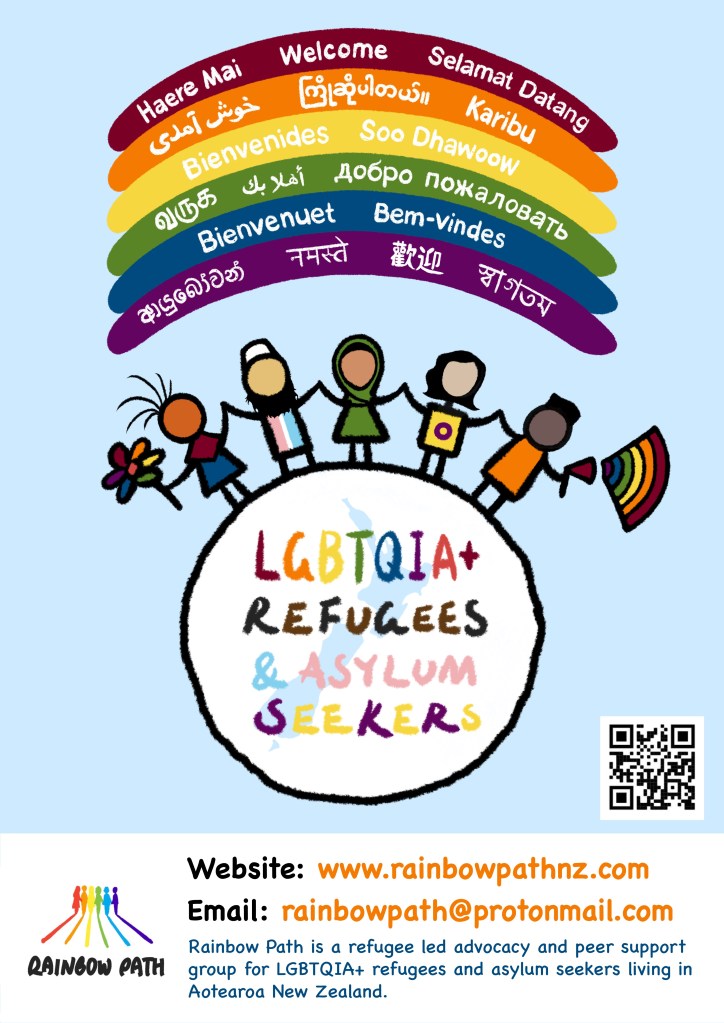
    A Rainbow Path poster saying welcome in many languages, with details about Rainbow Path's website (rainbowpathnz.com) and email (rainbowpath@protonmail.com )
    Rainbow Path poster with contact details

    What’s wrong with the Bill

    The Bill will make the process for changing sex details on a NZ birth certificate much simpler, based on a person’s self-defined identity. However, it:

    • fails to introduce any form of legal gender recognition for asylum seekers and refugees on temporary visas and
    • removes existing rights for quota refugees and migrants who have permanent residence.

    What you can do

    The Select Committee is asking people to make submissions on the final proposed changes to the BDMRR Bill. Those changes are contained in Supplementary Order Paper (SOP) 59. One of the examples mentioned explicitly on the Select Committee’s website explains how the SOP affects people born overseas. That proposed change says:

    • “that the self-identification provisions cannot be used to change the individual’s birth records from another country”.

    This means that legal gender recognition issues for asylum seekers, refugees and migrants are part of the Select Committee’s Inquiry.

    In our last blog, Rainbow Path explained the different issues each of these groups may face. Now that we have the wording of the SOP, we have developed some specific recommendations for the Select Committee.

    Rainbow Path is asking for your support for these three issues and recommendations

    Step 1: Read Rainbow Path’s key points and recommendations

    Below is a summary of Rainbow Path’s submission. People are very welcome to say you support our submission.

    1. The SOP and the Bill remove permanent residents’ existing right to legal gender recognition
    • Permanent residents born overseas will no longer be able to go the Family Court to get a Declaration as to Sex that has their correct sex recorded, based on their gender. This removes two existing rights:
      • Permanent residents who were born in other countries that have a gender recognition law (e.g. the UK), used that Declaration as to Sex from the NZ Family Court as evidence to change their birth certificate overseas. They will no longer be able to do that.
      • Permanent residents could use this Declaration as to Sex in Aotearoa as proof of their correct sex / gender. This is especially important for people whose overseas passport has their old name and/or sex marker.
    • This is a backward step for permanent residents, including quota refugees (who arrive here as permanent residents)

    Recommendation 1:

    • That the NZ government ensures permanent residents retain their right to obtain official documents with their correct gender and name, through an administrative process based on self-determination (self-identification) so that it is consistent with the changes the Bill is making for other trans, non-binary and intersex people in Aotearoa.

    2. The SOP and Bill provide no options for asylum seekers and Convention refugees on temporary visas

    The current legal situation

    Asylum seekers and Convention refugees on temporary visas cannot change their name in Aotearoa or go to the Family Court to get a Declaration as to Sex. The SOP and Bill will continue to explicitly exclude them because they were born overseas.

    • When an asylum seeker is recognised as a Convention refugee, New Zealand accepts that it is unsafe for this person to return to their country of origin and that they have nowhere else to go. Aotearoa is their home, and yet they cannot obtain an official document with their correct name and sex / gender marker.

    What Rainbow Path has been lobbying for

    Rainbow Path members have been lobbying since 2018 for asylum seekers and Convention refugees to be able to obtain official documentation with their correct name and sex / gender marker. Without such documents, they face immense barriers trying to access basic fundamental services, and potential danger every time they use outdated ID from their country of nationality.

    • This official document must not include the trans person’s original name or sex marker or in any other way disclose that they are trans. Doing so would pose significant safety risks for those fleeing persecution for being transgender, including for partners or family members overseas. This is why a document like a name change certificate is not a suitable option for transgender refugees and asylum seekers to use on its own to verify their identity.
    • A certificate of identity with the correct name and gender is potentially one solution, as it is a document that both the Department of Internal Affairs and Immigration NZ can issue for some asylum seekers people in Aotearoa on temporary visas. A refugee travel document from the Department of Internal Affairs can be issued to someone after their refugee status has been confirmed.

    Recommendation 2:

    • That the NZ government issues trans, non-binary and intersex asylum seekers and Convention refugees on temporary visas with an official document with their correct name and gender e.g. a certificate of identity issued by the Department of Internal Affairs and/or Immigration NZ.

    3. The Bill provides no options for other migrants in NZ on temporary visas

    The current legal situation

    • The existing Family Court process, the SOP and the Bill all exclude migrants living in New Zealand who are on temporary visas. Some may have lived in New Zealand for a long time.
    • Trans and non-binary people born overseas, particularly people of colour, are regularly asked to show their passport to prove their immigration status, including their ability to work or study here. They face significant challenges when they have no New Zealand documentation with a name and gender / sex marker that matches their affirmed gender.
    • Rainbow Path supports the need for a legal gender recognition process for these migrants too based on self-identification, for example through a statutory declaration process.
    • There is a growing number of countries overseas that allow migrants on temporary visas to change their name and/or sex details after living in the country for a minimum number of months or a year.

    Recommendation 3:

    • That the NZ government explores options for migrants on temporary visas to be able to obtain an official document with their correct name and gender through a simple, administrative, self-declaration process.

    Step 2: Explain why these issues are important to you

    It is really important to not just copy and paste our blog post. Use your own words to describe why these issues are important.

    Share your personal experiences, and your hopes that the government will ensure any trans, non-binary or intersex person living in Aotearoa can have an official document with their correct name and sex marker.

    If you don’t know a lot about the experiences of asylum seekers and refugees, there are still things you can say. Here are just two examples.

    • Most trans or non-binary people born in Aotearoa also know what it’s like not having a birth certificate with your correct details. Many have been able to change your NZ passport and use that as an ID, because that process is already based on a simple self-declaration form. Imagine what it’s like for someone who can’t change their name or sex details details on an overseas passport (or birth certificate) and isn’t eligible for a NZ passport because they are not a NZ citizen.
    • Migrants who aren’t trans will know how often people ask you to prove your immigration status in Aotearoa. Imagine what that’s like when none of your documents have a name, sex marker or photo that sounds or looks like you.

    Step 3: Make a submission online

    Gender Minorities Aotearoa:

    Send your submission to the Select Committee before midnight this Tuesday 14 September.

    • You can write your submission directly into the online form on the Select Committee’s website, or upload a file there.

    Thanks a lot for your support – together we can do this!

  • All trans and non-binary people in Aotearoa need legal gender recognition

    Rainbow Path has been lobbying for almost three years for legal gender recognition, so that trans and non-binary asylum seekers and refugees can obtain official documentation confirming their name and gender.

    Refugees and asylum seekers are continually asked to show our identity documents to prove who we are and that we are legally able to stay in Aotearoa NZ. Yet most trans and non-binary asylum seekers and refugees have to use ID documents that have the wrong name and/or gender marker. Most have us arrived from a country where it is not possible to change our name and/or gender marker – and Aotearoa NZ doesn’t allow anyone to change their name till they are a permanent resident here. This creates huge barriers including trying to open a bank account so we can get an emergency benefit, or convincing an employer that the work visa we are showing them was issued to us.

    Rainbow Path supports the Births, Deaths, Marriages and Relationships Registration (BDMRR) Bill that will make it simpler for people born in Aotearoa NZ to amend their birth certificate. We have lobbied against the Bill’s proposal that legal gender recognition is limited to people born here. Permanent residents must retain the right to obtain a formal NZ document confirming their correct name and gender.

    On its own, the Bill is not enough. There are also changes needed to other laws and policies, so that every trans and non-binary person living in Aotearoa has access to legal gender recognition – including asylum seekers and refugees and migrants on temporary visas. Rainbow Path has been lobbying on these specific issues for almost three years.

    Rainbow Path recently helped Gender Minorities Aotearoa update its submission guide on the BDMRR Bill highlighting some of these remaining gaps. When the final Bill comes out this month, we are asking others to raise these issues too.

    It is also important that submissions do not conflate the experiences of all people born overseas; for example, by making generalised statements about “trans migrants, refugees and asylum seekers”. There are differences between the experiences and legal barriers faced by each of these groups. Some are based on whether a trans or non-binary person is on a temporary or permanent visa or is a NZ citizen, and whether they are able to achieve any form of legal gender recognition in their country of birth or nationality. Listen to the diverse experiences of those who are directly affected by gaps in current laws and policies, and their recommendations.

    Read more in Gender Minority Aotearoa’s submission guide – under the three separate sections about legal gender recognition issues faced by:

    • asylum seekers and Convention refugees on temporary visas
    • migrants on temporary visas and
    • permanent residents born overseas.
    Trans person sitting at a desk writing a submission with posters on the wall behind her supporting the BDMRR Bill
    Source: Counting Ourselves report. Artist: Huriana Kopeke-Te Aho

  • Rainbow Path’s panel is back on!

    Register for this 15 July event

    Rainbow Path logo of 6 silhouettes in Rainbow colours, the Proud Centre logo and the title of this event "So Far to Go: the rights of refugees and asylum seekers.

    Rainbow Path’s Auckland Pride 2021 event is back on – and the timing is even better!

    The night before our February Pride event, Auckland went into lockdown. It took a while to find a new time that worked for all our amazing speakers. Listen to our great panel and learn how you support current campaigns to end the detention of asylum seekers and ensure asylum seekers, refugees and migrants can change their name and gender marker on IDs too.

    So Far To Go: The Rights of Asylum Seekers and Refugees
    When: Thursday 15 July, 7 – 9pm.
    Where: Ellen Melville Centre, 2 Freyberg Place, Auckland Central
    Cost: FREE
    Register: here
    This venue has an accessible toilet and is wheelchair friendly.

    Our expert panel includes:
    * The Green Party’s Refugee Spokesperson, MP Golriz Ghahraman
    * Rainbow refugees and asylum seekers
    * The Asylum Seekers’ Support Trust
    * Refugee lawyer Stewart Dalley
    * A member of the Immigration and Protection Tribunal.

    “So far to go” depicts both the distance Rainbow refugees and asylum seekers have travelled to Aotearoa NZ and the huge gaps in our immigration laws and policies that leave refugees and asylum seekers isolated with inadequate support, sometimes held in detention. Find out more about the changes needed to fully respect the rights of all refugees and asylum seekers in Aotearoa NZ – including additional challenges faced by those who are members of our Rainbow communities.

    COVID-19 has exposed the lack of support for asylum seekers and refugees in Aotearoa New Zealand, particularly those on temporary visas. It has also seen an increase in xenophobia and anti-immigration sentiments. How can Rainbow communities better support refugees and asylum seekers, including through advocating for changes to immigration policies?

  • So Far to Go panel postponed – stay in touch online for updates

    Rainbow Path’s So Far to Go panel on refugees’ and asylum seekers’ rights was scheduled for tonight, Monday 15 February, as part of the Auckland Pride festival. We regret that it has had to be postponed because Auckland is in Alert level 3.

    This panel is really important for us. So Rainbow Path will definitely still be holding the panel discussion – probably in March at the Ellen Melville Centre. It will be a great opportunity to find out more about the changes needed to fully respect the rights of all refugees and asylum seekers in Aotearoa NZ – including additional challenges faced by those who are members of our Rainbow communities.

    Rainbow Path is really glad that we were still able to have our stall at the Big Gay Out yesterday. A huge thanks to Refugees as Survivors NZ for booking the space and sharing it with us. We were an awesome team together.

    Rainbow Path reached out to our panel speakers last night and we hope to confirm a new date soon. We will also send everyone who registered for the panel discussion an email with the new event date.

    Follow us on our Facebook page, as we will also post updates there. Please help us promote our website too, so it comes up in online searches when people are urgently looking for support.